Every so often, Linda records Baluji talking through the memories that surface as they cook, eat, or simply sit and talk — small, unplanned conversations about the India he grew up in.
Recorded 28 July 2026.
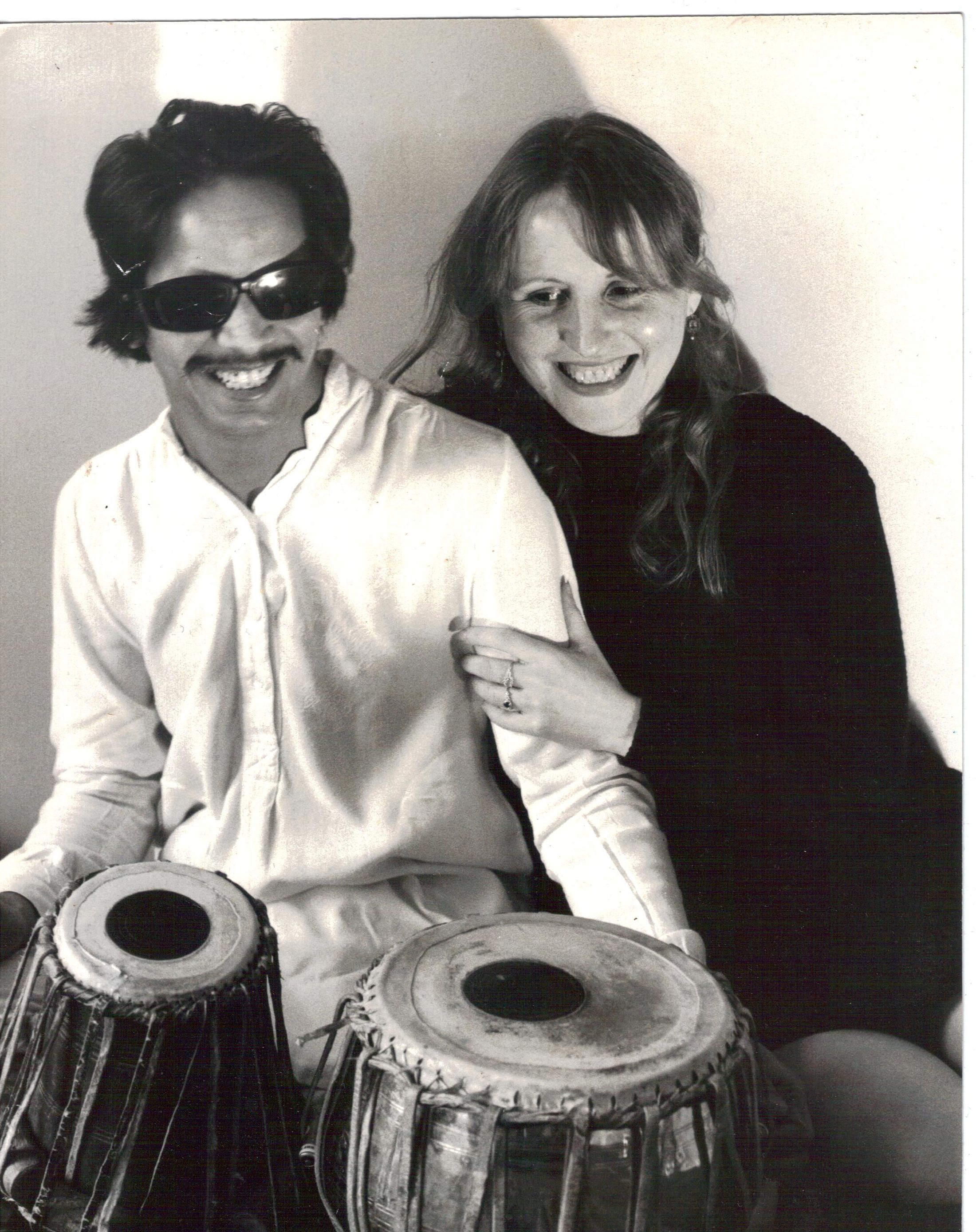
Sitar virtuoso Baluji Shrivastav OBE, in conversation with Linda Shanson — stories of a childhood in India, and reflections on a life in music.
Every so often, Linda records Baluji talking through the memories that surface as they cook, eat, or simply sit and talk — small, unplanned conversations about the India he grew up in.
Recorded 28 July 2026.
Linda: What about these pakoras you used to eat as a child?
Baluji: Those pakoras used to be very small and round and very smooth, and I used to enjoy them so much. In Ajmer Blind School, we used to have the same kind of pakoras, and I used to look forward to Friday, when there was pakoras for refreshment after school.
So in this school I used to just imagine that I'm going to have nice pakoras. And when I came to Europe, I had these pakoras — big Punjabi-style pakoras. I hate them! So I don't know when I will get those pakoras again.
When my mother used to make pakoras, I used to eat so many of them, she used to say, “Leave something for kadhi.” She used to make this besan kadhi, and those pakoras should go in there.
Linda: Were they the size of a pea? Were they that small, or were they bigger?
Baluji: No — how can I say — size of a grape? No. Of a plum? No, that's too big.
Linda: Size of a cherry?
Baluji: Cherry, yeah, cherry — that's right. Size of a cherry, but round and flat.
Linda: Round and flat. And what did you have them with?
Baluji: Pakodi with potato, pakodi with spinach.
Linda: And what was in the pakodi — just besan?
Baluji: Yeah, just besan.
— Baluji Shrivastav OBE, recorded by Linda Shanson
Linda: Remembering the smell and the feeling of the village — which village is this?
Baluji: Khanpur.
Linda: Okay.
Baluji: And Usmanpur. There are two villages we used to transfer in between. So I do remember, kind of similar.
Each curve of the terrace and the smell of cow dung, because we didn't have the cement thing, that every day — or if not every day, then every alternate day — they have to put the cow dung everywhere, to smell good and to smell lovely. And the smell of the butter, ghee, coming out of the milk, was so strong, I could just feel like I'm there. Also, thatched.
And yeah, also the curves, all the holes on top of this — instead of shelves, we used to have these holes, made naturally by people themselves. We didn't have to hire any labourers for it, just had to do ourselves.
Also, in the houses where there was no thatch, we used to put wooden beams. And I could feel — I still feel, when I'm describing — I feel different smells of different places. So we used to travel from house to the fields, and we had different smells of different kinds of corns, chickpeas, or barley.
— Baluji Shrivastav OBE, recorded by Linda Shanson
Baluji speaks to BBC Manchester ahead of an Inner Vision Orchestra performance at The Lowry, on founding the orchestra, the barriers he faced, and playing with Oasis, Annie Lennox and Coldplay.
Interviewer: First of all, Baluji, how would you describe the sound and the music that you and the orchestra make?
Baluji: We are international musicians, in London, that is. And London is a very, very good place, cosmopolitan city, finding all totally blind musicians from different nationalities. And here I should mention that I'm going to perform on 13th of November 2021 in Lowry, Manchester, and we are going to perform from five nationalities. That will be our second half.
The first half will be Indian classical music with a very, very famous tabla player called Shahbaz Hussain, and I'm very lucky to play with him. In this five-nationality performance, we'll be performing lots of different kinds of music — music from Nigeria, music from Japan, music from Lebanon, music from India, and music from South America.
Interviewer: You yourself are blind — why did you feel, almost ten years ago now, that you wanted to bring this orchestra with people with that disability together?
Baluji: The reason I have designed this Inner Vision Orchestra, because blind people are given the least platform anywhere, and especially because I have become, luckily, quite famous for various reasons. And they should be also famous because they are very good musicians, and they have been ignored because of their blindness, which is not fair.
And that's why I thought the Inner Vision Orchestra will perform, and people will see that we are as confident, as beautiful musicians, and as anybody can be. So, why not? We should be employed by wider orchestras, all orchestras all over the world.
Interviewer: When you were younger, what sort of barriers did you face as a musician that was blind?
Baluji: I have faced quite a few barriers in the sense that I didn't have a good publicity. The networking is a big problem for us. We can hear that lots of famous people have come, but we don't have anywhere to go and meet them. So we need someone to come with us and help us and so on and so forth. Networking is the big problem.
The other also, people used to think that, oh, he's blind, so if we employ him, someone, either someone else has to come, or we'll have a difficulty to take care of this person. And I have actually presented myself very independent. I said, look, all you have to do is tell me your address, where you want me, and I will be there, hopefully before you. And I have been there. And they're all surprised, how can you find all these places? Because those days, there was no Google Apps or anything like that to find. So I proved that. And I told them, shame on you, didn't respect my art. Blind people should be respected as everybody else.
Interviewer: Musicians that are sighted read their music. How do you know what you're playing?
Baluji: Music is to be heard and to be played, not to be read. This is — I'm totally against of it, because music should be — we can memorise quite a lot. And once we can see, of course, music is needed to be written, to be seen, but it has to be recorded as well. So we can have the recorded music, and from the recorded music, we can take our bits and remember those.
Also, especially the music I'm doing at the moment, Indian, Arabic, and in some sort of ways, Japanese as well, Nigerian, those sort of music can be improvised as well. And just a couple of lines we have to know, and then we can improvise. We can play our solos. That way we can also express ourselves. Indian music in special way that we only improvise, but we improvise most of the music. Ninety-five percent is improvisation.
Interviewer: I know you've worked with Oasis, with Kaiser Chiefs, with Annie Lennox. Was there a breakthrough moment for you that enabled you to break through those barriers and have the career you've had?
Baluji: Yes, of course, they believed in me and it's word of mouth. They contacted me and I just played with them either in recording and performances. Unluckily for me, I have not got any manager up to now. But without getting a manager, I have got lovely support of my wife who always helps me. And that's how I've got through everything. I'm very lucky to play with these lovely musicians. I have learned from those musicians a lot as well.
Interviewer: Is there a single standout moment for you as a musician from the work you've done?
Baluji: I just go and record in the studio, I just hear the track and I play with them. And yes, I have played with the Paralympics in 2012 — with Coldplay. That was a special moment for me because I didn't know, but people told me that he was sitting right next to me cross-legged, and that was a very good moment. Very special moment for me.
— Baluji Shrivastav OBE, BBC Manchester